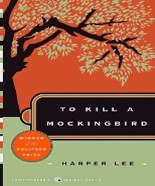
Bibliographic Information:
Title: To Kill a Mockingbird
Author: Harper Lee
Genre: Historical Fiction, Classics, Literature
Format: Book
ISBN: 9780060935467
Edition: Reprint
Publisher: Harper Perennial Modern Classics, New York
Copyright: 2002
Plot Summary: In the small town of Maycomb in 1930’s Alabama, Scout, Jem, and their father Atticus live through the Great Depression. Atticus is a lawyer, and so the two do not notice many of the Depression’s effects on their family, yet witness it through their neighbors, one of which being the infamous Boo Radley, a local boogieman to the children. Scout does not believe this and wishes to prove the other kids wrong. As the year passes by, Atticus chooses to be the defense attorney for an African American man named Tom Robbinson, who has been accused of rape and assault by a white woman. Due to this choice, Scout, and Jem face discrimination of their own as they learn of how racism can change the people they thought they knew into someone unrecognizable. How will the outcome of this case shape the town of Maycomb and the children like Scout and Jem in it?
Critical Evaluation: The main themes discussed here of racism and discrimination is one that has sat with me often after reading this novel. To look back in time to see that these injustices then have not been solved as of now leave a mark that is not so easy to wave away or ignore. Racism and discrimination take many forms in the novel as is does in our time today, as people’s biases hold fast in the face of admitting they were wrong like in the case of Tom Robinson’s trial and circumstances. However, as much of a reminder that these issues persist in society does the story serve as a reminder for how far we have come in tackling the issues in the first place. Hindsight is 20/20 as the saying goes, and as long as we remember the past and the sources of these issues, the more informed we and the young adults of the next generation are to find solutions to them.
Reader’s Annotation: An innocent African American man is falsely charged with assault in a small town in the 1930’s sees Scout and Jem learn from their defense attorney father, Atticus Finch, how the world is not as black and white as they believe.
About the Author: “Nelle Harper Lee was an American novelist whose 1960 novel To Kill a Mockingbird won the 1961 Pulitzer Prize and became a classic of modern American literature. She assisted her close friend Truman Capote in his research for the book In Cold Blood (1966). Her second and final novel, Go Set a Watchman, was an earlier draft of Mockingbird, set at a later date, that was published in July 2015 as a sequel. The plot and characters of To Kill a Mockingbird are loosely based on Lee’s observations of her family and neighbors in Monroeville, Alabama, as well as a childhood event that occurred near her hometown in 1936. The novel deals with racist attitudes, the irrationality of adult attitudes towards race and class in the Deep South of the 1930s, as depicted through the eyes of two children. Lee received numerous accolades and honorary degrees, including the Presidential Medal of Freedom in 2007, which was awarded for her contribution to literature” (GoodReads, n.d.).
Booktalk Ideas: A discussion of the time period and how things have and have not improved about racial issues.
Reading Level/Interest Age: 14+
Challenge Issues: Mentions of racism, sexual assault
Challenge Issue Resources:
- Our Collection Selection and Development Policy
- The Library Bill of Rights from the American Library Association
- Expanded Explanations of Interpretations of the Library Bill of Rights
- ALA Challenge Resources
- American Library Association Office for Intellectual Freedom
- FAQ for our librarians to help discuss youth access to library resources
- Our Rationale on Our Selections
- Material awards
- Material reviews
- Material information source: https://www.teachingbooks.net
- Active Listening Policy: All librarians will hear out challenges and challengers in full without bias. All librarians will take note of these challenges, offer resources available for further information on challenges and their processes, and offer to give the challenger our Request for Reconsideration form.
- Request for Reconsideration
- Reconsideration Resources
- Our Guidelines for Reconsideration and Processes
Why This Title: With many of the themes the book tackles still being evident in modern society, it is important to see how far we have come and how much we still have yet to improve upon.