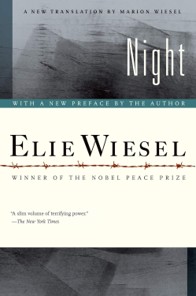
Bibliographic Information:
Title: Night
Author: Elie Wiesel
Genre: Memoir, Historical, World War II, Holocaust
Format: Book
ISBN: 9780374500016
Edition: Reprint
Publisher: Hill & Wang
Copyright: 1958
Plot Summary: Elie Wiesel writes of his youth and time in the detention camps within Nazi Germany during the Second World War as a Jewish person. The harrowing details of he and his family’s internment there paint a disturbing picture as only a firsthand account of the Holocaust could do. He describes how hard the loss of his father was, the difficulties he and his mother faced every day, and what they had to do to survive such an atrocity. With his eventual relocation to a different concentration camp and separation from his mother, Elie withstood much to eventually be rescued near the end of the Second World War. The scars and memories of his time may never fade, but he wishes to make sure the world knew of what happened to him and the other people in those camps to warn against the signs of fascism. May he and all those effected rest in peace.
Critical Evaluation: There is an air of melancholy around this title that is both expected and appropriate for the topic at hand. The Holocaust was something completely inhumane and evil, something that Wiesel communicates easily and well as someone who had survived it. Its messages to us and future generations to make sure that kind of genocide never happens again has been met with… mixed results. Currently as of 2026, the genocide of Palestinians in Gaza by Israel feels like a direct rebuttal of the goal Wiesel had, and with its continuation we may see more novels like Wiesel’s be written. I sincerely wish this will not be the case, as the message here is clear; no one should ever attempt to erase a whole group of people just for existing and being different from you. I wish for the young adults who read this novel to understand that and act accordingly.
Reader’s Annotation: The author recounts his time within a Nazi concentration camp to warn of the dangers of fascism and their signs.
About the Author: “Eliezer “Elie” Wiesel was born in Sighet, Romania on September 30, 1928. In 1944, he and his family were deported along with other Jews to the Nazi death camp Auschwitz. His mother and his younger sister died there. He loaded stones onto railway cars in a labor camp called Buna before being sent to Buchenwald, where his father died. He was liberated by the United States Third Army on April 11, 1945. After the war ended, he learned that his two older sisters had also survived. He was placed on a train of 400 orphans that was headed to France, where he was assigned to a home in Normandy under the care of a Jewish organization. He was educated at the Sorbonne and supported himself as a tutor, a Hebrew teacher, and a translator. He started writing for the French newspaper L’Arche. In 1948, L’Arche sent him to Israel to report on that newly founded state. He also became the Paris correspondent for the daily Yediot Ahronot. In this capacity, he interviewed the novelist Francois Mauriac, who urged him to write about his war experiences. The result was La Nuit (Night). After the publication of Night, Wiesel became a writer, literary critic, and journalist. His other books include Dawn, The Accident, The Gates of the Forest, The Jews of Silence: A Personal Report on Soviet Jewry, and Twilight. He received a numerous awards and honors for his literary work including the William and Janice Epstein Fiction Award in 1965, the Jewish Heritage Award in 1966, the Prix Medicis in 1969, and the Prix Livre-International in 1980. He received the Nobel Peace Prize in 1986 for his work in combating human cruelty and in advocating justice. He had a leading role in the creation of the United States Holocaust Memorial Museum in Washington, D. C. He died on July 2, 2016 at the age of 87” (Bowker Author Biography) (Kitsap, n.d.).
Booktalk Ideas: Discuss how and why the author wrote about his experiences.
Reading Level/Interest Age: 15+
Challenge Issues: Depictions of violence, neglect, Nazi’s
Challenge Issue Resources:
- Our Collection Selection and Development Policy
- The Library Bill of Rights from the American Library Association
- Expanded Explanations of Interpretations of the Library Bill of Rights
- ALA Challenge Resources
- American Library Association Office for Intellectual Freedom
- FAQ for our librarians to help discuss youth access to library resources
- Our Rationale on Our Selections
- Material awards
- Material reviews
- Material information source: https://www.teachingbooks.net
- Active Listening Policy: All librarians will hear out challenges and challengers in full without bias. All librarians will take note of these challenges, offer resources available for further information on challenges and their processes, and offer to give the challenger our Request for Reconsideration form.
- Request for Reconsideration
- Reconsideration Resources
- Our Guidelines for Reconsideration and Processes
Why This Title: Despite the heavy subject matter, the novel as a firsthand account of the Holocaust is a method for young adults to clearly remember what happened and the lessons Weisel is imparting.